Listening Circles and Letting Go: Inside America's Quiet Ambient Wellness Movement
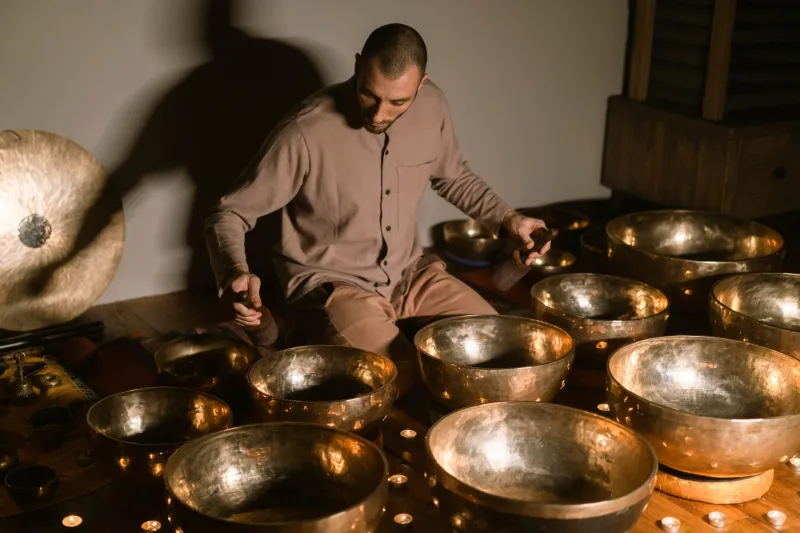
Somewhere in Portland, Oregon, a group of about twelve people sits in near-darkness on yoga mats and secondhand chairs, eyes closed, while a single sustained cello drone slowly unfolds from a speaker in the corner. Nobody is guiding them. There's no instructor, no app, no timer. The sound just moves through the room, and the people in it move with it — or don't move at all. That's kind of the point.
This is a listening circle, and variations of it are happening with increasing frequency in cities and small towns across America. Some are organized through Meetup groups or local community centers. Others live entirely online, in Discord servers and subreddit threads where members share long-form ambient recordings and describe the emotional and physical states they induce. What they all share is a belief — sometimes intuitive, sometimes backed by emerging research — that ambient music, when engaged with intentionally, can do something for the nervous system that most conventional wellness products simply can't.
Not Meditation, Not Music Therapy — Something In Between
It's worth being clear about what these communities are and aren't. They're not clinical settings. Most listening circles have no therapist present, no formal protocol, no diagnosis being treated. They occupy a genuinely novel space: somewhere between the structured practice of mindfulness meditation and the looser, more personal experience of just... listening deeply to music.
For many participants, that in-between quality is exactly what makes it work.
"I tried every meditation app. I tried therapy. I tried yoga," says Dani, a 34-year-old graphic designer in Minneapolis who has been attending a biweekly listening circle for about eight months. "None of them stuck the way this has. There's something about not being told what to do, not being guided through it, that lets my brain actually rest. I just follow the sound."
The sounds being followed in these spaces tend toward the long, slow, and textural: drone compositions, field recordings of rain or coastal environments, dark ambient works by artists like Stars of the Lid, Hildur Guðnadóttir, or William Basinski. The music often lacks conventional structure — no verse, no chorus, no climactic moment — which means the brain has nothing to anticipate, nothing to track. For people with anxiety, that absence of narrative tension can itself be therapeutic.
What the Research Is (Carefully) Starting to Say
Clinical music therapy has a long, established history, but ambient sound specifically is a newer area of inquiry. A handful of researchers are beginning to look at what's happening physiologically when people engage in extended, intentional listening to low-stimulation audio.
Dr. Camille Frost, a licensed clinical psychologist in Seattle who has begun incorporating ambient listening exercises into sessions with anxious clients, describes the mechanism in terms of the autonomic nervous system. "What we're essentially trying to do is shift someone out of sympathetic dominance — the fight-or-flight state — and into a more parasympathetic mode. Slow, predictable, low-frequency sound has a measurable effect on heart rate variability and cortisol levels. Ambient music, especially drone-based work, seems particularly good at this because it doesn't trigger the brain's pattern-recognition circuitry the way melodic music does."
She's careful to note that she's not prescribing ambient music as a treatment. But she's seen enough anecdotal results with clients to keep exploring it.
Online Communities Doing the Heavy Lifting
Much of the infrastructure for this movement lives online, and the communities that have grown up around ambient listening are some of the more genuinely supportive corners of the internet. Subreddits dedicated to drone music and dark ambient regularly feature threads where members describe using specific albums or recordings to manage panic attacks, insomnia, or the psychological aftermath of trauma. The recommendations are specific and personal in a way that no algorithm has yet managed to replicate.
"Someone posted about using Grouper's Dragging a Dead Deer Up a Hill to get through a really bad anxiety spiral, and like forty people replied with their own experiences with that record," says Theo, a moderator of one such online community with several thousand members. "That kind of thing doesn't happen on Spotify. There's real knowledge-sharing happening, real peer support."
Some of these communities have also become launchpads for more structured initiatives. A collective in Chicago called Quiet Signal has organized monthly in-person listening events that have drawn people in recovery from substance use disorders, veterans dealing with PTSD, and individuals managing chronic pain — all drawn by word of mouth and a shared sense that ambient sound offers something they hadn't found elsewhere.
The Limits and the Possibilities
None of this is a replacement for professional mental health care, and the community is generally thoughtful about saying so. Listening circles don't diagnose, don't treat, and don't claim to. What they offer is something more modest and perhaps more honest: a space to be with sound, and through it, to be with yourself.
There's also a real accessibility argument here. Mental health care in the US remains expensive and unevenly distributed. A listening circle costs nothing to attend. A field recording from Bandcamp might run three dollars. The tools are democratic in a way that most wellness industries aren't.
For the ambient music community — a world that has always prized depth of listening over passive consumption — watching this expansion into therapeutic territory feels significant. Ambient music was never just background. It was always an invitation to pay attention differently. The listening circles are just finally making that explicit.
If you've never sat in a dark room and let a drone wash over you for forty-five minutes, it might sound like nothing. But ask someone who has, and they'll probably tell you it was closer to everything.