While the World Sleeps, They Press Play: Inside Ambient's Midnight Nation
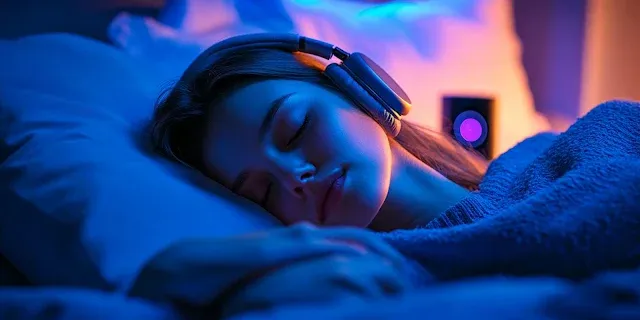
Photo: person lying awake in bed at night listening to headphones soft blue light, via blogger.googleusercontent.com
Somewhere around 2:47 a.m., the traffic on ambient playlists stops looking like a graph and starts looking like a heartbeat.
That's the pattern streaming analysts have noticed over the past three years: a slow, steady climb in overnight listening that peaks in the small hours and falls off just before sunrise. It's not teenagers up past their bedtime. It's not DJ sets. It's a sprawling, largely invisible audience — insomniacs, new parents, night nurses, cross-country truckers — for whom ambient music has become less of a genre and more of a companion.
And they may be the most loyal listeners in all of music.
The Numbers Nobody Was Watching
Streaming platforms don't break out overnight listening publicly, but multiple industry analysts describe the same trend: ambient and sleep-adjacent audio now accounts for a disproportionate share of plays between midnight and 5 a.m. One estimate puts the 10 p.m.–6 a.m. window at nearly triple the genre's share of daytime listening.
What's striking isn't just the volume — it's the duration. Daytime listeners sample a track and move on. Overnight listeners queue for hours. A single ambient album can log more total listening time from one insomniac than a pop record gets from a hundred casual fans.
"We used to think of ambient as background," says one label manager who asked to remain anonymous because of exclusivity negotiations with a major streaming service. "Now it's the only genre where your core audience is literally lying still in the dark for six hours straight."
America's Sleep Crisis, Measured in Streams
The context matters: roughly a third of American adults report getting less than the recommended seven hours of sleep, according to CDC data, and prescriptions for sleep aids continue to climb. Ambient music has quietly become a non-pharmaceutical first resort — cheaper than a sleep coach, less groovy than melatonin, and available instantly.
Dr. Elena Marsh, a behavioral sleep specialist in Chicago, sees the phenomenon from the clinical side. "Many of my patients arrive with a playlist already," she says. "The interesting part is what happens next. For some, slow, tonal music genuinely lowers arousal and eases sleep onset. For chronic insomniacs, though, it can become a crutch — the brain starts treating the music as a requirement. We call it conditioned arousal in reverse."
Her advice to patients is pragmatic: use ambient sound to wind down, but be wary of anything that keeps you awake listening. Which raises an obvious question for the genre: is music designed to be heard by people who are trying not to hear anything?
The Curators of 3 A.M.
Ask playlist curators what works at 3 a.m. and you'll get answers that sound like a rulebook for a secret society.
No sudden transients — a single plucked note at full volume can jolt a listener awake. No vocals, or at least none with words that trigger the language-processing parts of the brain. Slow attack, long decay. Drift, not drama.
One curator who runs a sleep-focused playlist with over 800,000 followers describes her vetting process in almost medical terms: "I test every track lying down, lights off, on low-volume earbuds. If my attention snaps to it, it's out. If it dissolves, it's in."
That test has real consequences for artists. "Sleep-safe" has become an unofficial production brief in certain corners of the ambient world — longer tracks (ten, twenty, even sixty minutes to minimize mid-night phone grabs), dynamic ranges compressed into a whisper, tempos that mimic a resting heart rate. Some composers now release work exclusively through sleep and meditation platforms, where per-stream payouts are lower but listeners stay for hours.
"I used to make records for people sitting in front of speakers," one Portland-based ambient artist told us. "Now I make rooms people fall asleep inside. It changed how I think about endings — there are none."
The Shift Workers Nobody Programs For
Insomniacs get most of the attention, but night-shift workers may be ambient's true heartland. Nurses, security guards, warehouse crews on third shift — people awake and functional while the country sleeps — have built their own listening culture around long-form drone and generative soundscapes that can run an entire shift without repetition.
On Reddit's r/ambientmusic and in Discord servers, the overnight crowd is easy to spot: they post at hours that read like distress signals, trading recommendations like "something for 4 a.m. that isn't sad." The community has developed its own vocabulary — tracks are described as "safe," "sturdy," or "able to carry me to six."
Where This Goes Next
Streaming platforms are paying attention. Sleep-focused playlists are among the most-followed editorial playlists on major services, and at least one platform is reportedly exploring a dedicated overnight listening mode — lower brightness, longer crossfades, no mid-track ads.
For a genre that spent fifty years being called boring, the midnight nation has delivered a strange kind of vindication. Ambient music doesn't need your attention. It just needs your hours.
And at 3 a.m., it turns out, there are a lot more of those than anyone realized.