Building a Room to Hear Nothing: Inside the Five-Figure Listening Room Boom
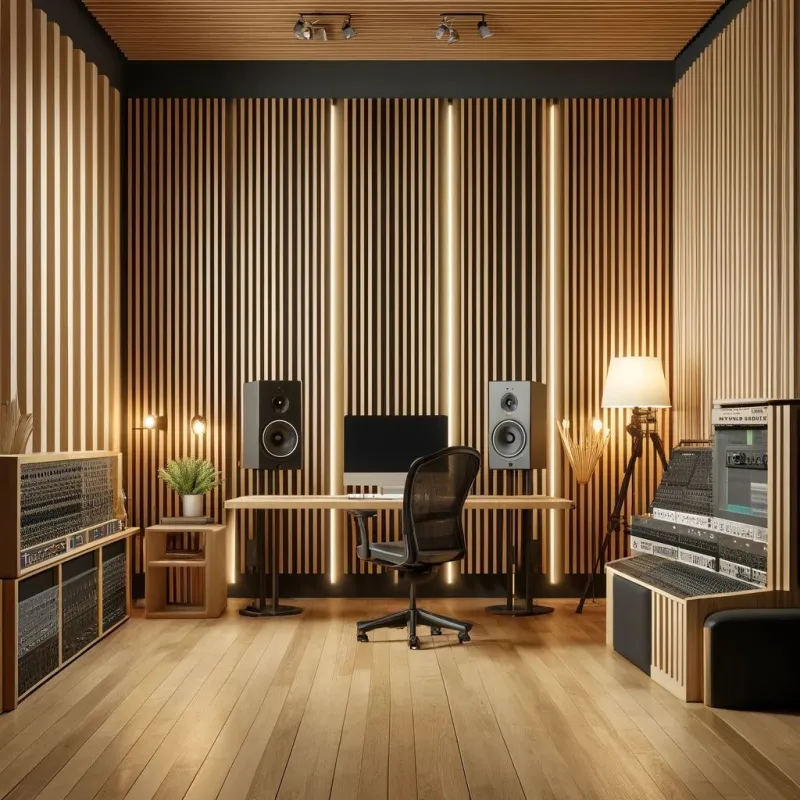
Photo: acoustic panel listening room interior home studio, via i.pinimg.com
Somewhere in a suburb outside Austin, there's a room with no windows, no TV, and no purpose except to be still. The walls are lined with fabric-wrapped panels. The ceiling is a lattice of wooden diffusers that look like modernist art. The owner spent north of $4,000 on a speaker system — and mostly plays recordings of rain falling on gravel.
Welcome to the listening room boom, where the ultimate flex isn't volume. It's vacancy.
The Death of the Home Theater
For two decades, the basement media room was the crown jewel of American home improvement. Big screen, bigger subwoofer, recliners with cup holders. But a quiet shift is happening in the AV industry: clients are asking designers to strip it all back.
"I used to spec seven-channel surround systems," says one integrator who works on high-end residential projects across the Southwest. "Now half my calls are people who want one great speaker, a chair, and walls that don't fight them."
The numbers back it up. Retailers report growing demand for acoustic treatment products — absorption panels, bass traps, diffusion — from customers who aren't audiophiles in the traditional sense. They're ambient listeners, drone heads, people who want to hear the room itself breathe.
What $4,000 of Silence Sounds Like
Here's the paradox that makes these rooms fascinating: the money doesn't buy sound. It buys the absence of everything else.
A well-treated listening room kills reflections, tames the HVAC hum, and seals out the leaf blower next door. What's left is what engineers call a "dead" room — and to the uninitiated, it's unsettling. Your own footsteps sound muffled. Your voice loses its edges.
Then the music starts, and everything makes sense. Ambient recordings — the genre built on space and decay — unfold with a clarity that's impossible in a normal living room. A single sustained tone seems to hang in the air like smoke. Reverb tails go on forever.
"Clients describe it as the first time they've actually heard the album," says one designer. "Not background music. The music."
Quiet Lounges and the New Aspiration
There's a cultural current underneath all this. After years of open floor plans and smart speakers in every room, a dedicated quiet space reads as luxury in a way a home theater no longer does. Real estate listings in markets like Portland, Nashville, and the DC suburbs have started leaning on phrases like "meditation room" and "sound studio" as selling points.
Call it the quiet lounge: part library, part sanctuary, part listening lab. Some owners furnish them with a single Eames-style chair. Others go full tatami-and-floor-cushion. The common thread is intentionality — a room that says we listen here.
You Don't Need Five Figures
The good news for the rest of us: the boom's core ideas scale down beautifully.
- Treat first, upgrade later. A few hundred dollars of absorption panels on first-reflection points will transform a spare room more than a new speaker ever will.
- Rugs, bookshelves, curtains. Irregular, soft, and dense beats bare drywall and glass every time.
- One good source. Ambient rewards quality over quantity. A single well-placed full-range speaker beats a surround rig for this material.
- Kill the noise floor. Door sweeps, weatherstripping, and a quiet HVAC setting matter more than any component.
The listening room boom is really about something older than hi-fi: the American urge to carve out one room that belongs entirely to you. It just happens that, this time, the room is designed to hold nothing but air — and whatever you pour into it.