Skip to the Good Part: How Streaming Playlists Flattened Ambient Into Mood Tags

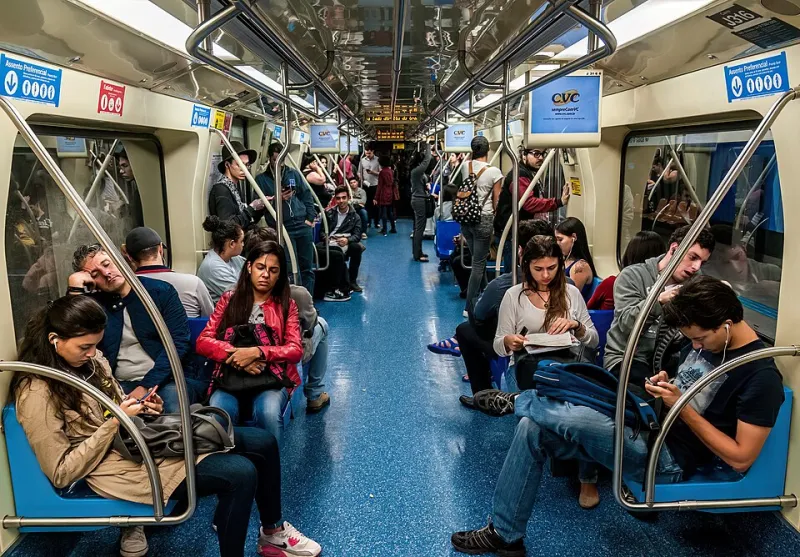
Photo: Shixart1985, CC BY 2.0, via Wikimedia Commons
It's 2:47 a.m. and you've been listening to the same playlist for two hours. You could not name a single track. You could not tell me where one ended and the next began. Somewhere around hour one a piano figure arrived, and it has either been going ever since or it has been replaced forty times by something functionally identical, and there is no way to know which.
This is not a failure of attention. It's a design outcome.
The tag replaced the album
Ambient music has always lived in a strange contract with its listener. Brian Eno's liner notes for Music for Airports proposed a music that was “as ignorable as it is interesting” — a deliberately double-edged promise. Interesting, if you lean in. Ignorable, if you don't. The form was built to survive both modes.
Streaming collapsed that double edge into a single, blunt instrument: the mood tag. Peaceful piano. Deep focus. Ambient sleep. Calm vibes. Study beats. These aren't genres; they're interfaces. They exist because the dominant search behavior on every major platform is not “I want this artist” but “I want this feeling,” and a taxonomy built around feelings has almost nothing to say about craft, lineage, or ambition.
“We stopped being a genre and became a setting,” says Hollis Vane, who runs the small Portland label Dovetail Editions. “Somewhere around 2021 the metadata stopped describing the music and started describing the listener's intended activity. Once that happened, the music started getting written for the activity.”
What the reward structure actually pays for
Talk to enough artists and a fairly consistent picture of the incentive ladder emerges.
A track needs to justify itself fast. Skips are read as a signal, and a skip at the forty-second mark is a louder signal than a save. So intros shrink. Silence gets trimmed, because silence reads as a dead file. Pieces settle into a narrow band of dynamics, because a track that dips to near-nothing gets mistaken for buffering or, worse, gets skipped by a listener who assumes the song is over. Tracks clock in under four minutes, because a long track holds a playlist slot hostage and playlist slots are currency.
The result is a catalog of ambient that is remarkably consistent in exactly the dimension ambient traditionally cared most about: time. You can build an eight-hour drone out of this stuff. You just can't put one in.
Then there's the mastering question, which nobody loves discussing. Ambient records are increasingly normalized to sit politely next to pop — which means the quiet parts aren't as quiet as the composer intended. The whole point of a lot of this music, historically, was that it asked you to turn the volume up and live inside the hiss. Now the hiss has been compressed into a pleasant beige.
Gatekeeping, with a submission form
Platforms do run editorial pitch systems — Spotify, for one, lets artists submit unreleased tracks for playlist consideration through its creator tools, with a lead time before release. But the editorial playlist is only the visible layer. Beneath it sits an ecosystem of algorithmic stations, third-party playlist networks, aggregator-curated background channels and, at the murkier end, paid placement brokers who will promise you a slot on a “chill” playlist with 400,000 followers and no listeners.
“I've had three different people offer to get me on the same playlist,” says Marisol Reyes, who records as Wet Meadow. “One of them wanted $300. One wanted a revenue split. One wanted me to ‘engage with the community’ first, which meant posting every day. None of them could tell me who listens to it.”
Label owners describe a subtler problem: the playlist gatekeeper's taste is not the genre's taste. Editors are optimizing for retention across a broad audience, which means the safest possible version of any given sound wins the slot. The strange version — the version with the cassette warble, the field recording of a parking garage, the piece that takes eleven minutes to become beautiful — goes to the algorithm, which has no idea what to do with it, and then to the bottom of the search results.
The defensible counterargument
Here's the thing: playlists work. For a lot of people, a mood tag was the front door. You heard something in a “deep focus” mix, you Shazam'd it, you fell down a Discogs hole, and now you own four Eliane Radigue records on vinyl. That's a real and common path.
The problem isn't that the doorway exists. It's that the doorway is the only door, and it leads to a hallway that loops back into itself.
Listening models that assume you're still there
A few alternatives are already working, mostly at the margins.
Album-side listening on Bandcamp, where the artist sets the price and the sequence stays intact. Community radio — NTS, dublab, college stations — where a human programs forty minutes and the transitions are arguments rather than seamlessness. Listening clubs, which have quietly proliferated in the last two years: a room, a good system, one record, no talking. Labels publishing annotated playlists with actual liner notes, so the metadata carries context instead of erasing it. The “one artist, one hour” format, which forces long-form work into a container that can hold it.
And the most radical option, which costs nothing: press play on an album and don't touch your phone.
“The thing I want back,” Vane says, “is the idea that a piece of music can end. That a fade-out isn't a failure. That a track can be boring for six minutes and then do the thing.”
That's not a mood. There's no tag for it. Which is, more or less, the point.